


Two things are happening to blind bags at once, and neither side knows about the other.
On the shelves at BoxLunch and Five Below they sit next to blind boxes and collectible toys, a cheap impulse buy for kids and gift shoppers. On Pinterest and YouTube, crafters fold their own paper versions from scratch, stuff them with handmade squishies, and film the reveal. Both are growing, and almost nobody connects them.
That connection is the useful part. People already want the sealed-surprise mechanic at a price far below a blind box, and a Shopify store can sell it as a real product line rather than a "surprise" label on a listing.
Key takeaways
- Blind bags are the cheapest sealed-surprise format: a flat pouch, one hidden item, shelved beside blind boxes at BoxLunch and Five Below.
- On Pinterest, YouTube, and Lemon8, crafters fold paper blind bags for fun. They are not sellers, but they prove the mechanic appeals far beyond collectors.
- Skip "grab bag" when researching demand. That search is owned by GRAB Bags, a tactical-gear company.
- A blind bag product line needs a defined pool, published odds, and random assignment at checkout, which Mysbox runs on Shopify.
- The margin lives in basket size, so price around multi-buy and a free-shipping threshold rather than around a single bag.

The retail format and the craft format, same mechanic
1. What a blind bag is
A blind bag is a small, flat, sealed pouch containing one item from a known set. The buyer cannot see or feel which one they are getting. Retailers such as BoxLunch, Five Below, and Walmart shelve them beside blind boxes as the cheaper, flatter cousin: the same mechanic in a smaller format at a lower price.
Packaging does real work here. An opaque foil or paper pouch, identical across the whole set, is what keeps the surprise intact. A pouch thin enough to feel through defeats the format entirely.
Four nearby terms get used interchangeably and shouldn't be:
| Term | What's inside | Package | Typical buyer |
|---|---|---|---|
| Blind bag | One item from a defined set | Flat sealed pouch | Kids, gift shoppers, impulse buyers |
| Blind box | One item from a defined set, often with a printed odds sheet | Sturdier box, higher price | Adult collectors chasing a specific figure |
| Mystery bag | Several items curated around a theme | Larger pouch or bag | Adults buying something closer to a gift |
| Grab bag | Assorted surprise items, generic usage | Anything | Casual shoppers; a poor search term |
"Grab bag" is real language, still used at church fairs and clearance bins. As a search term it is a dead end, because the results belong to GRAB Bags, a tactical-gear brand selling concealed-carry accessory bags. The idea behind the phrase still works, though: Shop Jobie, a Shopify store, set out to digitize the old-school grab bag concept with curated surprise boxes.
When you scope demand or benchmark competitors, use "blind bag", "mystery bag", or "surprise box" instead.
2. Why paper DIY blind bags became a craft trend
Paper DIY blind bags became a craft trend on Pinterest, YouTube, Lemon8, and Instagram, where kids and casual hobbyists fold their own pouches, decorate them, and fill them with handmade squishies or stickers before filming the reveal. The craft side looks nothing like the retail side, and almost none of it is aimed at selling.
The format has its own ecosystem of templates, printable wrapper designs, and "how I made mine" series, spread across Pinterest boards, YouTube channels, and Lemon8 posts. A typical tutorial folds an envelope from a single sheet, decorates the outside with a theme, fills it with a handmade item, and seals it for the reveal.
Kawaii and cute aesthetics dominate: fast-food-shaped pouches, animal and character envelopes, and papercraft squishy bags where the item inside is itself handmade. The appeal leans on the making as much as the opening, which is a different proposition from retail entirely.
What it is not is a cohort of businesses. These creators fold blind bags for the fun of the format, the way someone folds origami. There's no "how to sell your handmade blind bags" content sitting alongside the tutorials, and most aren't monetizing at all.
That's exactly why it's worth noticing. It is proof of mainstream appetite for the surprise-pouch mechanic across an age range far younger than the typical blind box buyer, and largely independent of any license. The craft audience mostly isn't buying retail blind bags, but the mechanic that hooks them is the one a product line can monetize.
It is also where a lot of first-time sellers come from. A crafter who starts listing handmade pouches on Etsy and then outgrows it faces the same decision as any maker moving to a Shopify storefront of their own.

The DIY version: fold, decorate, fill, seal and film
3. Retail styles that are selling
Four retail styles cover most blind bag listings at BoxLunch, Five Below, and Amazon. They are character and collectible bags, plush and squishy bags, mystery bags for adults, and surprise boxes. Each has a different buyer and price band, so the style you pick decides who the listing is for before you write a word of copy.
| Style | What's inside | Who buys it | Price band |
|---|---|---|---|
| Character and collectible | Small figures, keychains, pins tied to a theme or license | Youngest buyers, gift shoppers | Lowest in the category, impulse-buy territory |
| Plush and squishy | Soft, huggable items in a flat pack | Casual gift-givers, younger buyers | Low, near-checkout impulse |
| Mystery bags for adults | Several small items around a theme: beauty, stationery, snacks, novelty | Adults buying a gift or a treat for themselves | Higher, closer to a gift-box price |
| Surprise boxes | Same as above, framed around an occasion | Birthday, holiday and self-care gift buyers | Higher, presentation-led |
Rarity works in the collectible tier the way it does in blind boxes: most designs are common, and one or two per set are deliberately scarce. That scarcity is the engine of the chase, and it's the same scarcity trigger that drives card breaks and ichiban kuji at a far lower price.
The tier structure scales further than most sellers expect. STINGS, a Japanese character-goods brand, runs seven prize tiers online, an S-rank at the top and A through F below, each with its own configured win rate.
Searches for mystery bags for adults show real, distinct demand for the third row. It is a different buyer from the kids' collectible crowd, closer to a themed gift box than a toy, and they expect the contents to reflect that. Stock and market it separately rather than lumping every surprise product into one generic listing.
"Surprise box" overlaps heavily with mystery bag in what shoppers expect, but skews toward gifting occasions. The same product under that label sets gift-buyer expectations even when the mechanic is identical.
Price tracks format rather than brand. Character and plush sit at the low end, while curated adult bags run higher because they bundle more per package and lean on presentation. The multi-item rows behave like any other product bundle offer, which is also why they carry a higher basket than the single-item ones.
Pick the style your existing customers already match. A shop selling kids' toys or party supplies fits character and plush, while a beauty, home, or lifestyle shop fits adult mystery bags and surprise boxes. Shop Jobie built separate Men's, Women's, Kids', and holiday boxes for the same reason, so each one felt assembled for a buyer rather than thrown together.
4. Build it as a real product line on Shopify
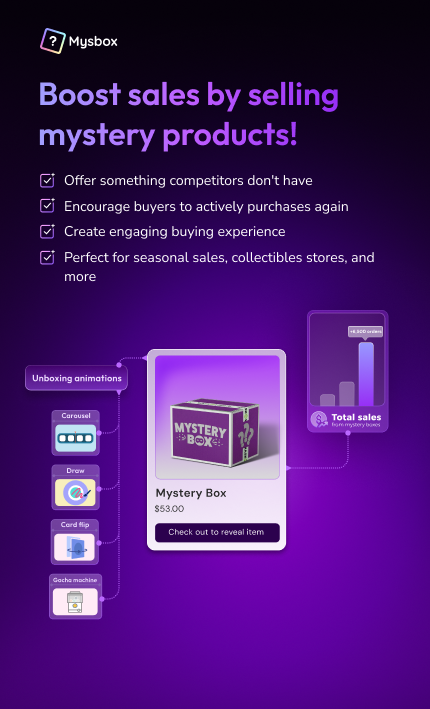
Selling blind bags as a product line on Shopify takes three pieces: a defined pool of items, odds the buyer can see, and random assignment at the moment someone buys. Mysbox runs that mechanic as an app, and stores like Shop Jobie and CardActivity use it to sell sealed-surprise products without assigning items by hand.
We built Mysbox by Qikify for this, and the setup runs in five steps.
- Define the pool. List every item and how many of each go into the drop.
- Set the odds. Your odds are your pool ratio. Mysbox calculates the drop rates from the quantities you enter, or you set rarity tiers by hand.
- Disclose them. Publishing the tier split is what separates a blind bag line from a shell game, and it costs nothing.
- Let assignment happen at checkout. Mysbox picks the item at random the moment the order is placed, so nobody on your side decides who gets the rare.
- Turn on buyback. Set a price at which a customer can sell a duplicate straight back to you. In a category where buyers already trade duplicates with each other, that moves the second transaction onto your store instead of someone else's marketplace.
The odds arithmetic is simple enough to publish as-is. A 100-unit seasonal drop with 80 common, 15 uncommon, and 5 rare designs gives every buyer a 5-in-100 chance at the rare tier. CardActivity, which sells Pokémon cards on Shopify through Mysbox at six price tiers, shows every pull chance before purchase for the same reason: buyers who can see the odds trust the drop.
A pool does not need to be large to feel varied. Shop Jobie's Women's Box on Mysbox draws from 20 possible items, which is plenty for a first Shopify drop. Before launch, check that the quantities in the pool match what is physically on your shelf, because the published odds are only honest if the stock behind them is real.
Volume is the reason assignment should not be manual. Blind bags sell at a lower price than blind boxes, so orders arrive faster and a store picking items by hand falls behind quickly. Gacha Gotcha hit that wall on earlier tools, where every result had to be triggered by hand, and moved to Mysbox on Shopify so customers trigger their own pull.
Multi-buy orders need the same care. When a buyer orders five bags, Mysbox batch unboxing opens all five together, so the order feels like one reveal rather than five separate checkouts.

Three common designs and a 5% rare, shown before purchase
Because the per-unit price is low, most of the economics come from basket size rather than margin per bag. Multi-buy offers do the heavy lifting: more pulls per order means better odds at the rare tier for the buyer and a higher average order value for you, which is the same reason bundles work everywhere else.
5. Price and pack it for a low-margin format
Blind bags are the thinnest-margin format in the mystery category. The two costs that decide whether a line works, packaging and shipping, are the ones sellers estimate last. At a Five Below price point, a Shopify store has to recover both through basket size, which is why multi-buy offers and Mysbox batch unboxing matter more here than in any other mystery format.
Packaging. The pouch has to be opaque and identical across the set. A bag a buyer can squeeze through isn't a blind bag, and a set where the rare design's pouch is visibly fuller is worse than not running the mechanic at all. Foil mailers cost more than paper and are harder to feel through, which is usually the right trade.
Shipping. A $3 bag with $5 shipping doesn't sell, which is why this format lives or dies on multi-buy. Set a free-shipping threshold in Shopify at three or four bags and the basket problem solves itself, while the buyer gets what they actually wanted, which is more pulls at the rare tier.
On price, work backward from the pouch. Take your landed cost per item, add packaging, divide the shipping cost across the minimum basket you're targeting, then set the price so the cheapest possible pull still clears all three. The rare designs make the set worth buying and the commons make it profitable, so the common tier has to carry real margin on its own.
One thing not to do: raise the price to fund a more impressive rare item. At this price point buyers compare against an impulse threshold, not against the contents, and a cheaper bag with an honest rare tier outsells a pricier bag with a spectacular one.
6. Where to go from here
Start with one drop, one theme, and a published rarity split on your Shopify store. A hundred units is enough to learn whether the theme lands and which tier sells through first, and small enough that a miss costs a weekend rather than a season. Shop Jobie treated its first Mysbox boxes the same way, as a launch phase to learn from.
Borrow one habit from the craft side: film the reveal, or let buyers film theirs. CardPriceCheck, a Pokémon card store on Shopify, found that customers sharing their Mysbox pulls brought in the next buyers.
Whatever you drop first, we'd love to see it.
Learn more: How to start a mystery box business on Shopify
Learn more: Mystery box niche ideas for Shopify sellers
Learn more: How the blind box and mystery box trend is playing out across Shopify stores
Learn more: Blind box toys: what's trending and how to source them
Ready to run your first drop? Set up your first pool with Mysbox today!
FAQ
Is a "grab bag" the same as a blind bag?
As a general term, yes. As a search term, no: results are dominated by GRAB Bags, an unrelated tactical-gear brand, so it's useless for research.
How do I make a simple paper blind bag at home?
Fold a small paper pouch, decorate the outside, stuff it with a small item or two, and seal it. That's the exact format filling craft tutorials on Pinterest and YouTube.
How many designs should a blind bag set have?
Enough that a buyer can't guess the outcome, and few enough that a full set feels collectable. Shop Jobie's Women's Box draws from 20 items, and STINGS runs seven tiers from S-rank to F.
What age group are blind bags marketed to?
Character and collectible bags skew younger. Mystery bags and surprise boxes marketed to adults are a separate category with a different buyer and a higher price band.
Is running a blind bag sale considered gambling?
Generally no, as long as every bag contains a real item of disclosed value and nothing is redeemable for cash. The full breakdown is in the mystery box business guide, and it's worth a word with counsel for your specific market before launching.
What's the price difference between a blind bag and a blind box?
Blind bags run cheaper, reflecting the flatter, lower-cost packaging. Adult-facing mystery bags price higher, closer to a gift-box range, since they bundle more per package.
Can I dropship blind bags instead of holding inventory?
No. The model depends on a real, finite pool of physical items on hand, which is exactly what dropshipping doesn't give you.


