


Cratejoy, Subbly, SumUp: good guides, wrong model. They're written for subscription boxes, and most people who search for how to start a mystery box business land on them looking for something else entirely.
Blind box toys, trading card breaks, blind bags: none of these run on a subscription. A mystery box is a one-time purchase. The customer pays once, gets a curated surprise, and either buys again or doesn't. There's no recurring billing to manage, no churn to track, and no monthly box to restock.
Two things trip people up almost immediately: how the random-assignment mechanic actually works, and whether any of this is legal. Both turn out simpler than they look. The mechanic is basic probability dressed up as retail theater, and the legal line is one sentence, not a maze.
1. Mystery box vs. subscription box: what you're actually building
A subscription box runs on recurring revenue. You curate a themed box every month, ship it to people who've committed to a standing order, and your whole operation revolves around keeping that subscriber for as long as possible.
A mystery box store runs on a single transaction. Someone buys a box (or a "spot" in a pool of prizes), finds out what's inside, and the sale is complete. There's no commitment on either side.
| Subscription box | Mystery box | |
|---|---|---|
| Revenue model | Recurring monthly billing | One-time purchase |
| What keeps it alive | Retention. Every cancellation has to be replaced | Repeat purchases, with no renewal to protect |
| Ongoing work | A new curated theme every month | One well-built pool, refreshed as items sell through |
| Customer commitment | Standing order | None |
| Best fit | Consumables and replenishment | Trend-driven categories: blind box toys, card breaks, blind bags |
That retention line is the real difference. Subbly's own merchant data puts median monthly churn at 7.44% across thousands of active merchants, which means a subscription business needs constant new signups just to stay flat. A one-time mystery box doesn't carry that overhead. Every sale is a full transaction, not a bet on next month's renewal.
Trend-driven categories move fast, too. A customer who wants a Labubu blind box wants it now, not a three-month subscription commitment to "maybe get one eventually." A one-time purchase model keeps pace with that in a way a subscription can't.

The Labubu and blind box trend
Learn more: Mysbox: Leverage the trend to boost your sales
You can absolutely run mystery boxes as a subscription too. Some merchants do both. But if you're starting from zero, the one-time model is the faster, lower-risk way in.
Learn more: Best Shopify subscription apps
2. How the random-assignment mechanic works
Almost nobody explains clearly what happens when someone buys a mystery box, and that's exactly what trips up merchants trying to figure out how to set their own odds.
2.1. Your odds are just your inventory ratio
The mechanic can vary depending on your strategy, but the simplest version is easy to set up: build a pool of items with different values, and set an inventory quantity for each one. The odds fall out of that ratio directly, no separate calculation needed.
For example, say you're selling 100 mystery boxes total, with 5 units of a $200 item and 95 units of a $10 item in the pool. The odds are already fixed at 5-in-100 for the high-value pull, because that's how many are actually in stock. Some spots are worth more than the price paid, some are worth less, and the pricing works because it averages out across the whole pool.
The same structure sits behind a handful of formats that already have real demand:
- Trading card "breaks." A seller opens a box or case live (often on video), buyers each own a random slot in advance, and whoever's slot matches a pulled card gets it.

Trading card (TCG) is one of the largest markets for selling mystery product concepts
- Ichiban kuji. A Japanese prize-draw format where every ticket in a batch wins something, and the tickets get pulled one by one until the batch runs out. Nobody walks away empty-handed.

Ichiban kuji or the figures/ collectibles market
- Fukubukuro (Japanese lucky bags). A fixed-price bag where the contents are hidden but the total value inside is guaranteed to exceed the price paid.

There are so many other selling concepts that are suitable for mystery products; Fukubukuro is one of them
Different packaging, same underlying logic: a defined pool, random assignment, and, ideally, transparent odds. That holds whether you're running an online mystery box with five items in the pool or fifty.
Publishing your odds is what separates a legitimate mystery box from something that looks like a shell game. If a customer can see "there's a 1-in-50 chance of the $200 item," they understand exactly what they're paying for before they buy. Most sellers who skip this step aren't hiding anything on purpose. They just haven't thought about odds as part of the product itself.
2.2. Three ways merchants use the mechanic
The mechanic does more than create a fun unboxing moment. Used well, it solves real merchandising problems.
- Rare pulls create FOMO. Put a genuinely rare or high-value item in the pool, and buyers show up for the chase, not just the product itself. It's the same scarcity trigger that makes card breaks and ichiban kuji work, and it applies to a $10 box as much as a $200 one.
- Mixed pools clear slow-moving inventory. Pair a hot item with slower sellers and weight the pool toward whichever one needs to move. More units of the slow mover means a higher chance of pulling it, which turns dead stock into part of the appeal instead of a write-off.
- Bundles stack both effects. Offer two or three boxes at a time with a discount, and more pulls per purchase means better odds of landing a rare item. That sharpens the FOMO while the multi-buy lifts average order value the way any product bundle offer does
3. Is a mystery box business legal?
Yes, if you run it right. The line between a mystery box and gambling comes down to one thing: does the customer always receive something of real, disclosed value?
A mystery box where every possible outcome has a legitimate market value, and where the odds (or at least the pool composition) are disclosed upfront, is a retail transaction. The customer knows what they might get and what it's worth. That's different from a wager, where the most likely outcome is walking away with nothing at all, which is the actual distinction regulators tend to draw.
This isn't legal advice, and rules vary by country and by exactly how a promotion is structured. Some jurisdictions treat "loot box" mechanics in games more strictly than physical mystery boxes, precisely because a game item has no independent resale value while a physical item does. If you're planning to run mystery boxes at scale, it's worth a quick conversation with a lawyer familiar with your market before launch, not after a complaint.
The operating principle that keeps most mystery box businesses on the right side of that line is simple: guarantee value, disclose odds, and don't dress it up as a game of chance.
4. Pick your mystery box niche
Everything downstream depends on the niche: sourcing, pricing, and who actually buys from you.
| Niche | Who buys | What to know |
|---|---|---|
| Blind box toys and designer figures | Young, highly online collectors (Labubu, Sanrio, Pop Mart-style) | The fastest-moving trend in the category right now |
| Trading card breaks | Established hobbyists with real collecting knowledge | Sold through live break events; the audience already understands the mechanic |
| Blind bags and mystery bags | Etsy-style small sellers moving up to a real storefront | The DIY-to-scale version of the same mechanic |
| TCG mystery boxes and repacks | Pokemon and sports card buyers | A slightly different buyer than single-card breaks |
| Beauty and skincare | Gift buyers and sampler shoppers | A smaller category, but consistent demand around gifting seasons |
| Food and snacks | International snack and mystery candy fans | Usually the easiest to source, the most competitive on price |
Go deep on one before spreading across several. Sourcing, pricing, and setup work the same way no matter which one you pick.
5. Source your first batch
Sourcing usually falls into one of three buckets:
- Closeout and liquidation inventory. The cheapest option, but quality and consistency vary batch to batch.
- A wholesaler in your niche. Costs more per unit, gives you predictable quality and repeat availability.
- Smaller brands who want distribution. Sits in between the other two, often at better pricing in exchange for helping them move inventory.
Whichever route you pick, check three things before committing: consistent volume, a clear return or defect policy, and whether you can verify the retail value of what they're sending you. That last one matters most, since your published odds are only honest if the values behind them are real.
Start small. A first batch of 20 to 30 boxes, sourced from one or two suppliers, tells you more about what customers want than any amount of planning. Scale the sourcing once you know which items move.
Every published figure for "how much it costs to start a mystery box business" online comes from a subscription-box context and isn't verified against a primary source, so it's not repeated here. The honest answer depends entirely on your niche and first-batch size, and a small first run keeps that number controllable.
6. Price the box so it's profitable but still feels like a deal
The pricing has to work two ways at once. It needs to cover your average cost per box (including the occasional high-value item) with real margin, and it needs to feel like a deal compared to what's inside.
The way that usually works: price the box below what the average item in the pool is worth on its own, while making sure the floor value (the cheapest possible outcome) still covers your cost.
For example, say your pool runs from a $5 item up to a $150 item, averaging $22 across the whole pool. Pricing the box at $18 to $20 feels like a deal against that average, while still protecting your margin as long as that price sits comfortably above what the $5 item actually cost you to source.
If your cheapest possible item is worth less than your average cost per box, you're underpricing, and it'll show up in your margins first. Run the break-even math on the pool before you commit to a price, not after the first batch sells through.
Test with a small batch before committing to a price. Real sales data on which pool compositions sell will tell you more than any pricing formula.
7. Build the pool and set it up on Shopify
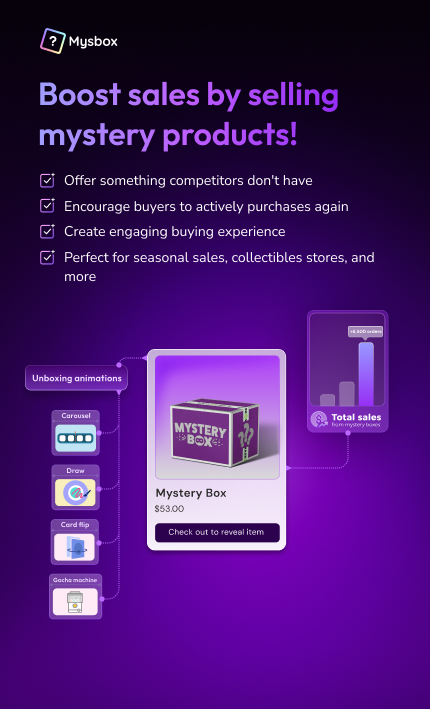
A handful of Shopify apps handle exactly this mechanic already, no custom development required. We built Mysbox by Qikify to be one of them: you set up your pool of items, define the odds, and the app handles the random assignment and reveal at checkout, so customers know exactly what they got the moment they buy.
Learn more: Koin and Mysbox join the Qikify ecosystem
Turning your Shopify store into a mystery box website looks like this:
- Build your pool. List out every item you're including and its real market value.
- Set your odds. Decide how many of each item go into the pool, weighting it toward whatever needs to move, and confirm the math covers your cost at the floor value.
- Configure the reveal. Mysbox handles the random assignment and shows the customer their result right after purchase, with a gamified reveal moment rather than a plain order confirmation.
- Turn on buyback (optional). Mysbox lets you set a buyback price for items in the pool, so a customer who pulls something they don't want can sell it straight back to you at the price you set.
- Publish and test. Run a test purchase yourself before going live to confirm the odds display matches what you configured.

Setting up a mystery product with Mysbox Mystery Box Builder app on Shopify
Buyback is worth a closer look if your niche skews toward collectors. It answers the objection that stops a lot of first-time mystery box buyers ("what if I get something I don't want?") without putting you in the refund business, since you're buying the item back at a price you control rather than handing money back on a completed sale. The item lands back in your inventory too, ready to go into the next pool.
In trading cards and blind box toys, buyers already resell duplicates to each other. Buyback just moves that step onto your store, where it turns into a second touchpoint with the same customer instead of a listing on someone else's marketplace.
That covers the two hardest parts of building a mystery box store manually: writing the randomization logic yourself, and building a way to show customers their result without a support ticket. Mysbox handles both, along with the gamification layer (spin animations, reveal moments) that turns the unboxing into a moment worth filming.
If you already have a Shopify store, adding a mystery box product line with an app like this is a matter of hours, not weeks. That's the biggest practical difference between "I've been thinking about doing this" and actually shipping a mystery box store this month.
8. Market your mystery box launch
Selling mystery boxes is less about hard-selling and more about giving buyers a reason to film themselves opening one. This is one of the few product categories where the marketing partly happens for you, if you set it up right.
Unboxings are the core mechanic. Encourage buyers to film opening their box. A good unboxing video does more to sell your next batch than any ad copy, because it shows real, undoctored outcomes, and buyers trust that far more than a product photo.
Micro-influencers beat broad reach here. Card break streamers, toy-collecting accounts, and snack-box reviewers convert better for this category, since their audience already understands the mechanic and trusts what they're seeing. A single well-placed streamer opening your box live can outperform a much bigger, less-targeted campaign.
A referral loop compounds. Give a buyer a discount on their next box for referring a friend. Merchants who sell mystery boxes well tend to lean on this early, since it compounds naturally in a category people already like sharing on TikTok and Reddit.
9. Mistakes first-time mystery box sellers make
Not disclosing odds or pool composition clearly enough. The most common one, and the easiest to avoid. Transparency upfront costs nothing and prevents most complaints before they start, since customers who know what they're buying rarely feel misled afterward.
Pricing around the best-case item instead of the average. It's tempting to price against the flashiest possible outcome, but that quietly erodes margin every time a high-value item goes out. Price against the average, not the headline item.
Launching too many niches at once. A merchant who tries blind box toys, card breaks, and beauty boxes simultaneously usually sources all three poorly instead of one well. Each niche has its own suppliers and its own buyer expectations, so splitting attention from day one means none of them gets sourced or priced properly. Pick one, prove it works, and expand from there.
10. Where to go from here
The setup above is the same regardless of niche. What changes is sourcing, pricing psychology, and where your buyers actually hang out online. Start with whichever category matches what you already sell, or already understand as a buyer yourself. That's almost always the fastest path to a first successful batch, since you'll spot a bad supplier or a mispriced pool faster than someone starting cold.
Whichever niche you pick, we'd love to see what you build with it.
Ready to launch your first mystery box? Set up your first pool with Mysbox today!
FAQ
1. Is a mystery box business considered gambling?
Not if every outcome has real, disclosed value and the odds are transparent. It becomes a gray area when outcomes are hidden or when a "loss" (getting nothing at all) is possible.
2. Do I need to disclose the odds of each item?
It's not always legally required, but it's the single biggest trust builder for this category.
3. What happens if a customer is unhappy with what they get?
Since every item in the pool has real value, most stores handle this through clear upfront disclosure rather than post-purchase refunds. Some offer a partial credit for low-value pulls, but it isn't required once the odds were disclosed.
4. How much money do I need to start?
It depends on your niche and first-batch size. A small first run of 20 to 30 boxes is the lowest-risk way to find your real number before scaling.
5. Can I add mystery boxes to a store that already sells regular products?
Yes, and that's how most merchants start. The mystery box runs as its own product line alongside everything else, using the same catalog and checkout.
6. Do I need a special app, or can I build this manually on Shopify?
You can build it manually, but you'd be writing your own randomization and reveal logic from scratch. An app like Mysbox handles that mechanic already, so most merchants start there.


