


Most mystery box advice stops the moment the box is built: pick a niche, price the pool, film an unboxing.
A mystery box marketing strategy has a second half: where the offer sits on your Shopify store, and how you know it paid. Those two decisions separate a box that lifts AOV before Black Friday from one nobody finds.
Key takeaways
- Place the offer on three surfaces of your Shopify store: the product page, the cart, and the reveal screen.
- Show the drop rates where the offer is made, next to the buy button.
- The second sale happens seconds after the first, while the buyer is still looking at a result.
- Judge the offer after 30 days on order value, repeat buyers, and how often pulls get sold back.
1. What a mystery box marketing strategy covers
A mystery box marketing strategy on Shopify comes down to seven decisions. Five happen before launch, from pricing the pool to getting the first unboxing filmed for TikTok. The last two decide the return: where the offer sits on the store, and how you read the result in Shopify Analytics.
The first five are well covered already, so each gets one line and a link.
Why it sells: Curiosity and the chance of a rare pull do the work. The same draw sits behind the Labubu and Pop Mart blind box craze, and we cover why shoppers buy the unknown separately.
Format and price: A single-prize box suits a chase item, a bundle box a mixed pool. Price against the average pull, as our guide to pricing a mixed pool shows.
Niche: The box has to match what you already sell, and we compared 16 mystery box niche ideas by demand and difficulty.
Launch: Unboxing videos, niche creators, and a referral loop carry most launches, since buyers already share their pulls on TikTok and Reddit.
Learn more: How to start a mystery box business on Shopify
2. Tell a mystery item from a mystery box
A mystery item and a mystery box are different offers, and most published results describe the first. Zipify's OneClickUpsell team reported on three Shopify Plus stores selling one hidden product as an upsell: Calm Strips, Manta Sleep, and CurlMix. A mystery box is a pool with odds, a reveal, and a chance at a rare pull.
Zipify reports that Calm Strips made over $16,000 at a 57% conversion rate. Manta Sleep brought in $12,297.50 at up to 16.9%, and CurlMix $8,000 at 22%. Those are Zipify's own client figures with no time period given, and each offer was a single hidden add-on.
What carries over to a randomized box is the price logic: a cheap add-on that fits most carts gets taken.
The odds, the reveal, and the second purchase don't carry over, and those are what a mystery box upsell sells.
The box usually works as both: the product page carries the full offer, and a low-priced tier travels as the add-on.
3. Place the offer where the buyer decides
A mystery box offer has three homes on a Shopify store, and each does a different job. The product page sells the odds, the cart adds a low-priced tier, and the reveal screen sells the next box. Goose & Gander, a Shopify Plus brand, added a homepage countdown and a landing page for its Black Friday box.
| Surface | Job it does | Box that fits | What must be visible |
|---|---|---|---|
| Product page | Sells the offer on its own | Any tier, including the chase box | Value range, drop rates, recent pulls |
| Cart | Adds a box to an order in progress | The lowest-priced tier only | The price and a hint at the contents |
| Reveal screen | Sells the second box | The same box, or the next tier up | The result, the buyback price, an open-another prompt |
3.1. Product page: sell the odds, not the contents
A regular product page shows the product, and a mystery box product page can't. Three things have to stand in for the missing photo.
- The value range. State the floor as well as the ceiling, so the worst pull still reads as fair.
- The drop rates. List the odds per tier next to the buy button, not in a policy page.
- Proof of a top pull. A feed of recent pulls shows the rare item is real and has been won.
Does showing the odds cost you sales? We don't think it does, because a hidden pool reads as a markdown bin and gives careful buyers a reason to leave.
STINGS, a Japanese character goods store in our case studies, runs a seven-tier pull from S-rank down to F, each tier with its own win rate.

(Example) The page can't show everything about the product, so it shows the odds and the proof instead.
3.2. Cart: a low-priced box as the add-on
The cart is for the cheapest tier and nothing else. A buyer mid-order will add a small surprise, but won't stop to weigh a three-figure chase box.
For hidden add-ons, Zipify's advice is to keep the item under $20. Manta Sleep ran its offer before purchase with no discount at all. Both points apply to a box used as a cart upsell on Shopify: keep the price low and skip the markdown.
Build that tier from a pool most of your buyers would want.
3.3. After the reveal: the second sale
The best moment to sell a second box is seconds after the first one opens.
The buyer either wants another shot at the top item or wants rid of what they pulled.
In Zipify's case study, CurlMix sold $8,000 in mystery products with a hidden-item offer. A standard post-purchase offer on Shopify stops there, while a mystery box has two more moves.
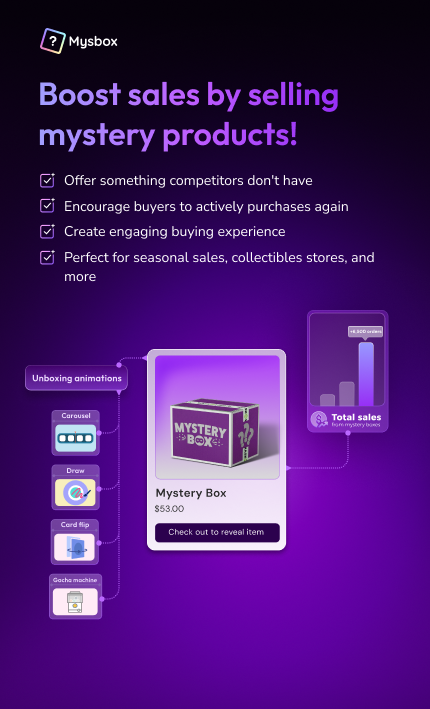
- Open another. In Mysbox, our mystery box app, the buyer sees an Open more prompt after unboxing and again after a resell. One click takes them to a cart already loaded with the same boxes.
- Buyback. The buyer trades an unwanted pull back at a price you set, and spends that value on the next box.
A win-back email arrives weeks later, while this second sale happens with the buyer still on the page.
4. Set the offer up with Mysbox
We built Mysbox by Qikify to cover all three surfaces from one pool on Shopify. You add the prizes and their quantities, the app works out the odds, and the buyer unboxes online. It also works with Shopify Flow and with store credit from Koin.
Here's how to sell mystery boxes on Shopify with each surface switched on:
- Build the pool. Add each prize and how many units go in. The odds follow from those counts, or you can group items into rarity tiers and set the rates yourself.
- Publish the product page. The drop rates appear on the page, along with Recent pulls from other buyers.
- Let buyers open online. They unbox one box at a time or several in a batch, with an animation for each reveal.
- Set a buyback price. Each item gets a trading price, so a buyer can resell a pull and go again.

The reveal screen is the third surface, and the only one a regular product doesn't have.
If you're still comparing tools, we reviewed the main Shopify mystery box apps side by side, ours included.
5. Measure whether the offer worked
Give the offer 30 days, then read three numbers: AOV, repeat box buyers, and buyback rate. Shopify Analytics gives you the first, and the Mysbox analytics track repeat box buyers alongside box sales. Box sales alone tell you people were curious, not whether the offer earned its place on your Shopify store.
| Metric | Where to read it | A weak reading means |
|---|---|---|
| AOV on orders with a box, against orders without | Shopify Analytics | The box is replacing a product instead of adding to the order |
| Repeat box buyers | Mysbox analytics | The reveal isn't selling the next box |
| Buyback rate | The buyback requests you accept | The common pulls are unwanted, or the trading price is too low to bother with |
Order value: In Shopify Analytics, compare AOV on orders that include a box against orders that don't, across the same 30 days. For example, say orders without a box average $48 and orders with one average $61. Then the box is adding to the cart, which is the average order value gain you wanted. If both sit at $48, buyers are swapping a product for the box.
Repeat box buyers: Count the buyers who opened a second box inside those 30 days. The format is built to move this number, so rank it above box sales.
Buyback rate: Divide the pulls sold back by the pulls opened over the same period.
A high rate says the common items are unwanted, and a low one says the trading price isn't worth a click.
One margin detail is easy to miss: accept a buyback before fulfillment and that item never gets packed or shipped.
You keep the sale and skip the packing and postage for that item.

Read this view after 30 days, not after the first weekend.
6. Time the offer for Black Friday
A mystery box promotion needs one change before Black Friday and Cyber Monday: a deadline. Goose & Gander sold a £45 box worth £69 to £147 over the 2021 weekend. We Make Websites reports the store took over 13,000 orders, with sales up 105% year over year to £650,000.
Keep the pool and the odds as they are, and add a countdown with an end date.
To reward buyers without a markdown, try a mystery box that pays out in store credit through Koin.
Learn more: Black Friday marketing for Shopify stores: The 2026 playbook
Whichever surface you start with, we'd love to see the box you place on it. Set up your first mystery box offer with Mysbox today!
FAQ
Do mystery boxes raise average order value?
They can, when the box is added to an order instead of replacing a product in it.
Is a mystery box upsell the same as a product bundle?
No, a bundle shows every item up front, while a mystery box hides the item and publishes the odds.
Do I need a separate landing page for a mystery box?
Not to start, since a landing page only earns its place once you run a dated campaign.
Will a mystery box pull sales away from my full-price products?
Watch full-price sales of the same items in Shopify Analytics, and tighten the framing if they drop.
How often should I release a new mystery box?
Refresh the pool when repeat box buyers flatten out, since a new top prize beats a new box name.
Can customers pay for a mystery box with store credit?
Yes, Mysbox works with Koin Store Credit & Cashback, so a buyer can spend their store credit on a box.


